The tiles
A riichi set has 136 tiles: three suits of numbers 1–9 (four copies of each) plus seven kinds of honor tiles (four of each). That's it. Ten minutes with this page and you will read any hand diagram on this site — and any real table.
The three suits
Each suit runs 1 to 9, four copies of every tile. Suit names are worth learning in Japanese — players use them constantly.
Characters 萬子 · manzu

The only suit that uses kanji numerals. If you memorize nothing else: 一1 二2 三3 四4 五5 六6 七7 八8 九9. In notation these are written 1m–9m.
Circles 筒子 · pinzu

Bamboo 索子 · souzu

The 1 of bamboo is drawn as a peacock or sparrow on nearly every set in the world. Every beginner asks; now you know.
Honor tiles 字牌 · jihai
Seven kinds, no numbers, four copies each. They cannot form sequences — only pairs, triplets, and kans.
Winds 風牌
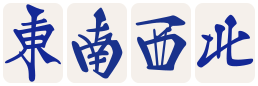
Each player has a seat wind, and each round has a round wind. A triplet of your wind or the round wind is a yakuhai — one of the fastest ways to a valid hand.
Dragons 三元牌
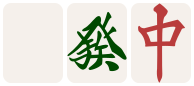
Dragon triplets are always yakuhai, for every player, in every round. And yes — the white dragon really is a blank tile on Japanese sets. It is not a spare.
Red fives 赤ドラ · akadora
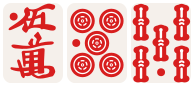
Most modern riichi sets swap one normal 5 in each suit for a red one. A red five in your winning hand is worth one extra han — it is a dora, a bonus, not a yaku. Playing “aka-ari” (with red fives) is the modern default; tournaments sometimes play without.
What riichi sets don't have
Coming from Chinese or American mahjong: riichi uses no flower or season tiles and no jokers. 136 tiles, nothing else. Japanese tiles are also noticeably smaller (26–30mm tall versus 38–42mm for Chinese sets) — which is why riichi sets and Chinese automatic tables often don't mix; see the comparison lesson for the rest of the differences.
Reading the notation
This site (and the wider riichi community) writes hands compactly: numbers plus a suit letter —
234m is 2-3-4 of characters, 0p is the red five of circles, and
honors are 1z–7z in the order east, south, west, north, white, green,
red. You never need to type it — every hand here is drawn as tiles — but you will meet it in
the community.
Next: Lesson 2 — the shape of a hand, where these tiles start forming sets.