Turns, discards, and calls
Every turn in riichi has the same two beats: draw one tile, then win or discard one. Your hand sits at 13 tiles between turns, 14 only for the moment you're deciding. Calls — chii, pon, and kan — are the one way to break that rhythm, and they cost more than beginners expect.
The loop
Play runs counterclockwise from the dealer. On your turn you take the next tile from the wall, look at your 14, and either declare a win or place one tile face up in front of you. Then the player to your right does the same. That's the whole engine of the game — everything else in riichi is built on top of this loop.
Discards stay on the record
Discards don't go into a shared heap. Each player lays their own discards face up in neat rows of six, oldest first, directly in front of their hand — and they stay in order for the whole hand. Don't rearrange them.
That tidiness is load-bearing. Your discard row is a public record of what you haven't needed, and two of the game's biggest mechanics rest on it: furiten フリテン, which blocks you from winning off a discard if your winning tile is sitting in your own row, and defense — opponents read your row to judge which tiles are safe to let go. In riichi, discards are information, not trash.
Calls: interrupting the loop
When another player discards a tile your hand needs, you can sometimes claim it. You say the call out loud, take the tile just discarded, reveal the completed set, and then discard — play continues to your right, which means a call can skip other players' turns entirely. There are three calls.
Chii チー — finish a sequence, from your left only
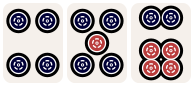
Chii claims a discard to complete a run: you hold 4p and 6p, the player on your left drops the 5p, you call "chii" and take it. The restriction is strict — chii only works on the player to your left, the one whose discard comes right before your normal draw. A tile from across the table or from your right cannot be chii'd, no matter how badly you want it.
Pon ポン — finish a triplet, from anyone
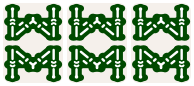
Pon claims a discard to complete a triplet: you hold two 8s, anyone at the table discards the third, you call it. No seat restriction. Because play jumps straight to you afterward, a well-timed pon can rob one or two opponents of a turn.
Kan カン — declare four of a kind
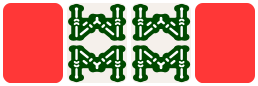
Kan declares a quad. It comes in three forms: a closed kan (all four tiles from your own draws), an added kan (adding the fourth tile — freshly drawn or already in hand — to a triplet you ponned), and an open kan (claiming the fourth from any player's discard). Every kan does two things: you draw a replacement tile from the dead wall — the reserved section you met in the setup lesson — so your hand keeps its shape, and a new dora indicator is flipped, raising the potential value of everyone's hand. One detail worth holding onto: a closed kan does not open your hand. You can still declare riichi after one.
When two calls collide
Priority is fixed: ron beats pon and kan, and pon or kan beats chii. A player winning on the tile always takes it; a chii only stands if nobody wants the tile for a triplet or quad. (If two players declare ron on the same discard, rulesets genuinely differ — some award both wins, others only the player closest in turn order.)
The price: your hand is now open
The called set doesn't go back into your hand. It sits face up at the edge of the table by your play area, with the claimed tile turned sideways so everyone can see whose discard fed it. From the moment you chii, pon, or open-kan, your hand is open — and a whole tier of value disappears:
- No riichi. The signature declaration is closed-hand only.
- No menzen tsumo. The self-draw yaku requires a closed hand.
- No pinfu, no iipeiko. Both exist only in closed hands.
- Several yaku shrink. Sanshoku, ittsuu, and chanta, among others, drop a han when the hand is open — see the yaku list for which.
And remember from the start: a winning hand needs at least one yaku. Riichi is the beginner's everything-yaku, and calling throws it away.
When the call clearly buys speed and the hand still has a yaku. The classic case is ponning a dragon or your own wind — the triplet itself is a yaku, so the hand stays legal and gets faster. As a rule of thumb: if you can't name the yaku your open hand will win with, don't call.
Kuikae: the swap-call restriction
One restriction to know before your first live game. Kuikae 喰い替え (swap calling) means calling a tile and then immediately discarding a tile that fits the same set — either the identical tile (chii a 5p into 4p-6p, then discard your other 5p) or the sliding version (holding 3-4, chii a 2, then discard the 5 that would have completed the same run from the other end). The call changes nothing about your hand except the turn order, so most rulesets forbid it — WRC rules included. Treat it as a standard restriction, not an exotic one.
Previous: Lesson 3 — setup and the wall. Next: Lesson 5 — riichi, where staying closed starts paying off.